Claude Code Cannot Rescue an Unclear Product Plan
When the user, scope, dependencies, acceptance criteria, and definition of done are missing, even capable code generation can move quickly in the wrong direction.
The Advanced Claude Expansion
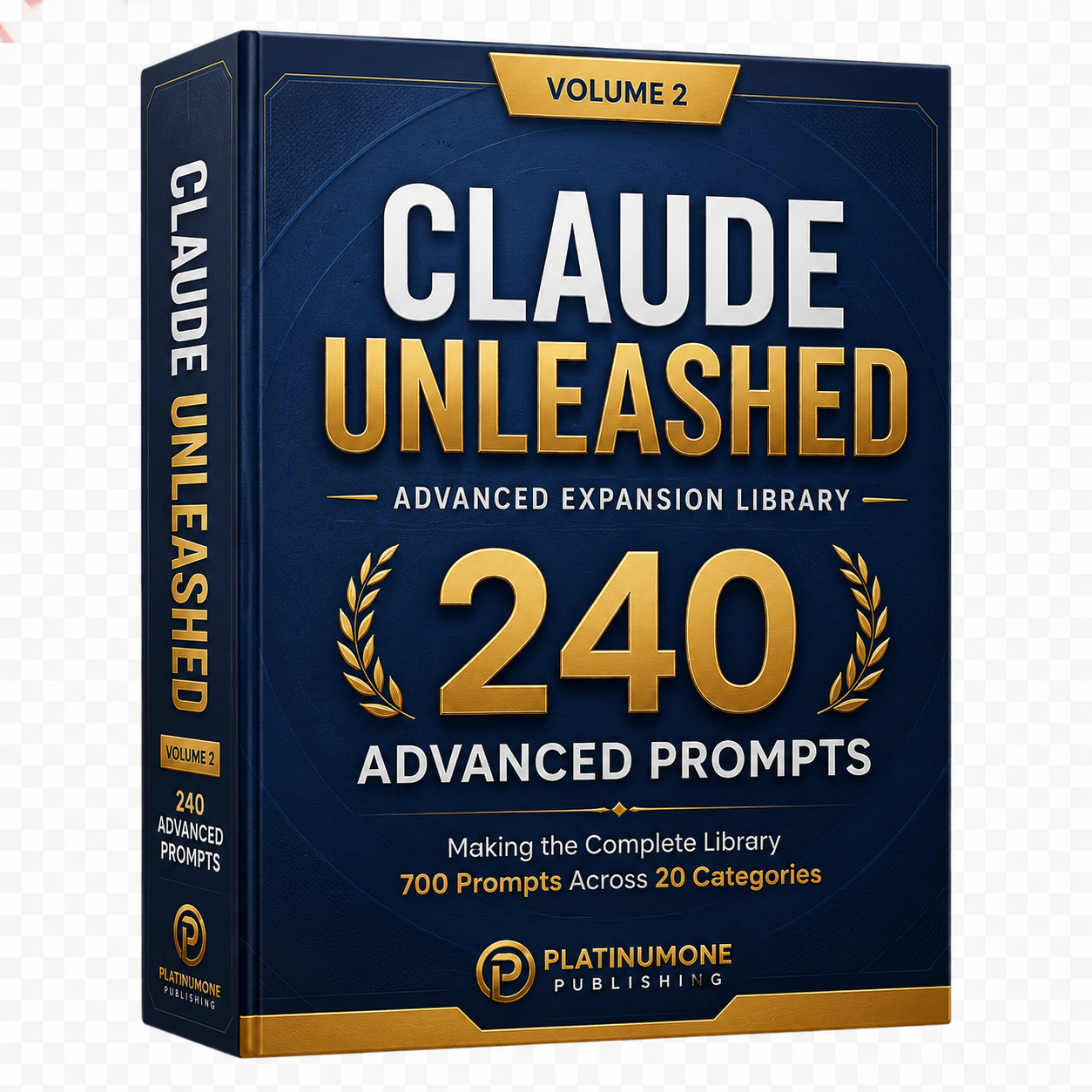
Volume 2 adds 240 advanced prompts across 10 categories covering Claude Code, Cowork, Projects, Skills, MCP, Extended Thinking, Vision, API and agentic design, research, and more sophisticated business workflows.
$47
Secure PayPal checkout. Delivery unlocks only after verified payment capture.
More Leverage Requires More Precision
Advanced Claude tools create more leverage, but they also increase the cost of vague instructions.
When the user, scope, dependencies, acceptance criteria, and definition of done are missing, even capable code generation can move quickly in the wrong direction.
Autonomous file and task workflows need exact goals, boundaries, output locations, error handling, and a clear list of what must not change.
Live data reduces copy and paste, but it also raises privacy, permission, verification, and human-approval questions that a casual prompt may ignore.
Agentic workflows require tools, limits, acceptance criteria, failure paths, and escalation rules. Autonomy without a review design is not a business system.
Volume 2 helps you define the task before execution, identify what can fail, and preserve the checkpoints where human judgment remains necessary.
The Advanced Transformation
The Complete System teaches deliberate business prompting. Volume 2 takes you deeper into tools and workflows that can plan, connect, analyze, and execute across a broader environment.
Move toward a build-ready PRD with a defined user, MVP boundary, technical constraints, acceptance criteria, testing requirements, and handoff plan.
Move toward a controlled Cowork brief with source folders, naming rules, protected files, error handling, expected outputs, and review checkpoints.
Move toward connector-aware workflows that identify available data, privacy boundaries, verification steps, and actions that still require approval.
Move toward persistent Projects, specialized Skills, reusable context, and clear routing for recurring work.
Move toward Extended Thinking, document intelligence, deeper research, API integrations, and agentic systems designed around explicit quality standards.
Verified Product Depth
Volume 2 is a separate advanced expansion with dedicated Claude Code and Cowork categories plus Projects, Skills, MCP, Extended Thinking, Vision, API, agents, research, business operating workflows, and advanced prompt engineering.
No full paid prompt is reproduced on this page.
240
10
24
The Real Category Map
Every category below was verified against the supplied Volume 2 PDF. The descriptions summarize business uses without publishing the protected prompt text.
Category 11 - 24 Prompts
Plan MVPs, PRDs, architecture, codebase reviews, debugging, tests, security audits, migrations, CI/CD, session handoffs, and multi-agent software workflows.
Review boundary: Clear requirements and quality gates reduce wrong-direction builds. Production code still requires testing, security review, and technical validation.
Category 12 - 24 Prompts
Brief file management, document processing, research collection, meeting preparation, publishing, client deliverables, recurring reviews, invoicing, and other business tasks.
Review boundary: Autonomous work needs explicit boundaries, acceptance criteria, error handling, and human approval points.
Category 13 - 24 Prompts
Design Project Knowledge, persistent instructions, specialized Skills, routing rules, research methods, support workflows, and reusable working environments.
Review boundary: Persistent context should be reviewed and kept focused so outdated or unnecessary information does not distort results.
Category 14 - 24 Prompts
Plan workflows using compatible Gmail, Google Drive, Notion, Slack, calendar, repository, and other connected information where available.
Review boundary: Connected data increases capability and privacy responsibility. Verify permissions, sensitive data boundaries, and every consequential action.
Category 15 - 24 Prompts
Structure high-stakes decisions, first-principles analysis, scenarios, strategic tradeoffs, risk reviews, and complex reasoning tasks.
Review boundary: Treat recommendations as decision support. Important conclusions still need evidence, judgment, and appropriate expert review.
Category 16 - 24 Prompts
Analyze interfaces, extract structured document data, review images, examine charts, transcribe visual material, and organize document intelligence.
Review boundary: Visual extraction can be uncertain. Ambiguous text, numbers, and fields should be flagged and checked against the source.
Category 17 - 24 Prompts
Plan Claude API integrations, system prompts, multi-turn applications, testing and versioning, retrieval workflows, tool use, and agent specifications.
Review boundary: API and agent systems need cost controls, error handling, permissions, observability, rollback plans, and production testing.
Category 18 - 24 Prompts
Design deeper research questions, synthesize multiple sources, identify contradictions, document uncertainty, and turn findings into usable decisions.
Review boundary: Research quality depends on source quality. Claims, citations, recency, and unresolved gaps require verification.
Category 19 - 24 Prompts
Support CEO reviews, planning, metrics interpretation, operating rhythms, documentation, decision support, and repeatable cross-business workflows.
Review boundary: Claude should support accountable decisions, not silently replace ownership, financial controls, or human judgment.
Category 20 - 24 Prompts
Reverse-engineer stronger prompts from desired outputs, debug weak instructions, build evaluation criteria, and create prompt-improvement systems.
Review boundary: Prompt changes should be tested against real use cases before replacing a reliable production workflow.
Move from unclear requests to prompts designed around the tool, risk, information, and definition of done.
Dedicated Cowork Coverage
Volume 2 includes a dedicated Cowork category. Use its advanced prompt approaches for document processing, file organization, meeting preparation, content publishing, research collection, client-deliverable packaging, recurring business tasks, billing workflows, and review routines.
State the exact goal, files involved, output format, destination, timing, dependencies, and acceptance criteria.
Name what Cowork may change, what it must not change, how to handle missing or conflicting files, and when to stop for human review.
Access and safety: Volume 2 provides prompts for Cowork workflows; it does not include Cowork access. Availability depends on the buyer's Claude plan, account, location, and current Anthropic availability. Cowork can make mistakes and should not be treated as unsupervised authority for consequential work.
Dedicated Claude Code Coverage
Volume 2 includes a dedicated Claude Code category for MVP planning, PRDs, architecture, codebase review, debugging, security audits, technical documentation, migrations, CI/CD planning, development handoffs, and agentic software workflows.
Define the user, required workflow, essential features, technical constraints, dependencies, tests, acceptance criteria, and definition of done.
Protect existing behavior, establish quality gates, require approval before risky changes, and document a rollback or recovery path.
Production boundary: Software and automation outputs should be tested, reviewed, secured, and validated before production use. Volume 2 does not guarantee complete or production-ready software.
The Complete Library Path
The Complete System contains the foundational 500-prompt business library, 12-module course, workbook, visual guides, and 90-day roadmap. Volume 2 adds 240 advanced prompts across Categories 11-20.
500
Core business prompting, implementation, content, marketing, products, strategy, and operations.
Explore the Complete System240
Claude Code, Cowork, Projects, Skills, MCP, analysis, Vision, API, agents, research, and advanced workflows.
Get Volume 2 - $47740
Purchase both libraries for a combined 740 prompts across 20 categories.
Volume 2 is separate from the $97 Complete System. It is $47 standalone and may be offered as a $27 eligible checkout bump. Prices and eligibility are controlled by the existing checkout configuration.
Before You Add Volume 2
No. Volume 2 is a separate 240-prompt advanced expansion. The Complete System contains its own 500-prompt foundational library and implementation materials.
Yes. Category 12 is dedicated to Cowork task delegation and workflow automation, with 24 prompts.
Yes. Category 11 is dedicated to Claude Code software development and agentic builds, with 24 prompts.
No. The product provides prompt instructions. Claude Code, Cowork, connectors, API access, and other features depend on the buyer's Claude plan, account, location, configuration, and current Anthropic availability.
Volume 2 can be purchased separately, but it is designed as the advanced expansion after the foundational business-prompting and implementation system.
No. Some work should remain manual or require approval. Consequential actions, connected data, code, payments, legal matters, security, and production systems need appropriate human review.
After verified PayPal payment capture, the site unlocks the protected delivery page and tokenized download for the Volume 2 PDF.
No. Claude is a trademark of Anthropic, PBC. This independent product is not affiliated with, endorsed by, sponsored by, or officially connected to Anthropic.
Add the 240-prompt expansion and direct more advanced Claude capabilities with clearer boundaries, quality gates, and review points.
Use 240 advanced prompts across 10 verified categories to plan code, delegate tasks, connect information, design agents, analyze complex work, and build stronger business workflows.
$47
Software, automation, connected-data, and autonomous-task outputs require appropriate testing and human review.